Papering Over the Problem: When Your Contractor Agreement Is a Wage Claim Waiting to Be Filed
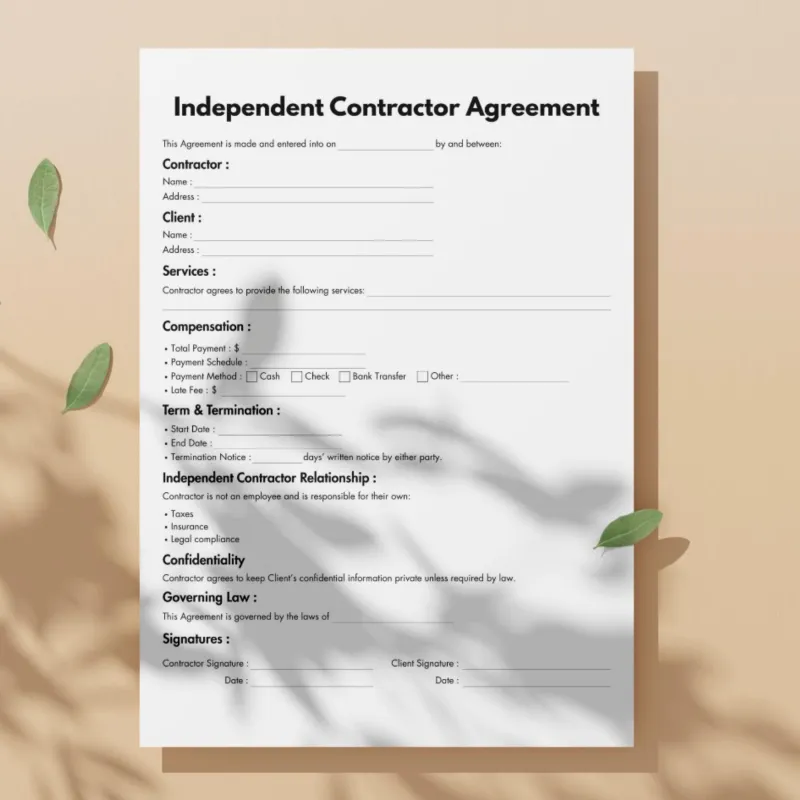
Photo: independent contractor signing agreement desk office, via i.etsystatic.com
There is a persistent belief in American business that the label on a document controls its legal consequences. Call the person a contractor, attach a well-negotiated agreement, issue a Form 1099, and the matter is settled. Counsel has reviewed the vendor paper; procurement has filed it away; everyone moves on.
The trouble is that no court, no state labor agency, and no examiner at the Department of Internal Revenue reads an agreement in isolation. They read the relationship. And when the relationship looks like employment, the most carefully drafted contractor agreement in the world becomes, in effect, an exhibit for the other side.
The Agreement Is Not the Test
Misclassification disputes are decided under a patchwork of tests: the IRS common-law factors, the FLSA's economic realities framework, the DOL's 2024 independent contractor rule, and state-specific regimes such as California's ABC test, New Jersey's version of the same, and the varied standards in Texas, New York, and Massachusetts. A company operating across state lines may be compliant in Houston and exposed in Sacramento under identical facts.
What these frameworks share is a focus on conduct rather than captions. Examiners ask who controls the work, whether the worker has a genuinely independent business, and whether the arrangement could survive economically apart from the putative employer. The signed agreement informs the analysis; it rarely decides it.
Three Patterns That Convert Contractors Into Employees
In our review of misclassification matters, three recurring patterns account for a large share of adverse findings.
Embedded supervision. When the company assigns a manager to direct the contractor's daily tasks, requires attendance at stand-ups, or evaluates performance with the same rubrics used for employees, the control factor collapses. A contractor who reports to a supervisor in all but name is, functionally, an employee.
Indefinite, open-ended terms. Agreements that continue month to month with no defined project, no completion milestone, and no renewal analysis signal permanence. Longevity alone is not dispositive, but an arrangement that persists for years without re-examination looks like a job, and tribunals treat it as one.
Exclusive dependence. A contractor who works solely for one client, uses the client's equipment, and has no meaningful market for services elsewhere fails the independence inquiry under most tests. Exclusivity provisions in the agreement compound the problem by documenting the very dependence that undermines the classification.
These patterns rarely emerge from a single decision. They accrete. A project extends, a manager tightens oversight, a renewal happens by inertia. By the time a claim arrives, the relationship bears little resemblance to the one the agreement describes.
What a Misclassification Finding Actually Costs
The exposure is rarely limited to back wages. A single misclassification determination can trigger employer-side payroll taxes, overtime liability under the FLSA, state unemployment and workers' compensation assessments, penalties under IRC Section 3509, and — in the private lawsuit — fee-shifting provisions that make even modest wage claims expensive to defend. Where the ABC test applies, the worker may be deemed an employee unless the company can prove all three prongs, a burden that is difficult to satisfy retroactively.
There is also a quieter cost: the unraveling of the vendor agreement itself. Arbitration clauses, indemnification terms, and limitation-of-liability provisions negotiated at arm's length may be recharacterized or disregarded once the relationship is recast as employment. The carefully constructed allocation of risk dissolves precisely when it is needed most.
A Checklist for Re-Papering the Relationship
Companies that audit contractor relationships proactively can usually cure most problems with modest changes. We recommend an annual review built around the following questions:
- Does the contractor maintain a real business? Look for a separate entity, other clients, independent marketing, and business insurance.
- Who directs the work? The agreement should specify deliverables and deadlines, not methods, schedules, or supervision.
- Is there a defined term? Every engagement should have a project scope, an end date, and a documented renewal decision — not silent continuation.
- Is exclusivity necessary? If so, understand that it raises classification risk and price that risk accordingly.
- Does the contractor use their own tools? Equipment, software, and workspace should belong to the contractor wherever practical.
- Have you tested the governing states? An arrangement compliant under the FLSA may fail the ABC test. Multistate portfolios need multistate analysis.
- Is the agreement consistent with practice? If reality has drifted from the paper, either fix the practice or fix the paper.
For relationships that cannot be squared with any test, the honest answer is conversion: bring the worker on as an employee, or restructure the engagement through a staffing agency or professional employer arrangement that absorbs the classification risk.
Clarity Before the Audit Letter
Misclassification disputes are won and lost long before any examiner arrives. They are won by companies that treat the contractor relationship as a living arrangement requiring periodic review, not a document signed once and forgotten. The gap between what the agreement says and what the relationship is will always be discovered — the only question is whether your counsel finds it first or a plaintiff's lawyer does.
A structured audit, conducted annually and documented in writing, converts an unquantified liability into a manageable compliance program. That is the kind of clarity complex decisions deserve.